
First quantumsafe connection for government marks a new era in data security
Amid rows of cables and racks in one of RINIS’ data centres stand a few unassuming black cabinets. While they may appear to be ordinary hardware, these cabinets house the first quantum-safe connection in a government data centre – a first for digital government. This marks an important step toward a government network that can protect sensitive data from future cyberattacks.
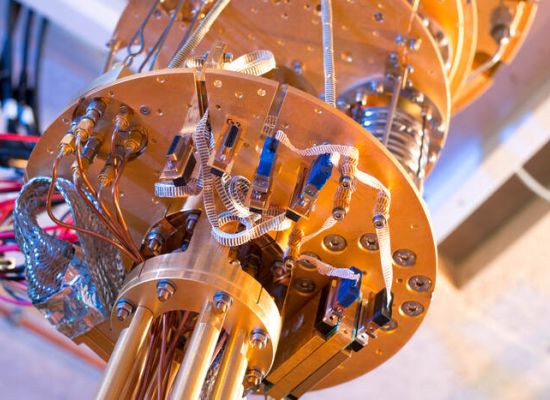
Governments transmit vast amounts of sensitive data every day. Currently, this data is protected using classical encryption. However, the advent of quantum computers is set to disrupt this standard, as they will be capable of cracking today's encryption with relative ease. The General Intelligence and Security Service of the Netherlands (AIVD) has warned that ‘Q-Day’ (a term used to refer to the moment when quantum computers can break widely used cryptography) could arrive as early as 2030. Quantum computers will then enable malicious actors, such as hostile state actors, to bypass much of today’s cryptography.
This presents major risks for government agencies, because the confidentiality, integrity and availability of information and processes will be seriously threatened. Moreover, there is the threat of “harvest now, decrypt later.” Malicious actors are already capable of storing encrypted data – from personal user data to a wide range of sensitive information – in the hope of decrypting it in the future. Once powerful quantum computers become available, they will be able to do so easily. The risk of “harvest now, decrypt later” is greatest for publicly accessible or long-stored encrypted data that can be intercepted by third parties.
The AIVD and the National Cyber Security Centre of the Netherlands (NCSC) have put out a joint publication, Make your organisation quantum-safe, in which they emphasise that government agencies need to transition to quantum-safe cryptography as soon as possible. Any party concerned with protecting confidential data must begin transitioning now. And that is what RINIS is currently doing.
Quantum mechanics as protection against future cyber threats
A futureproof method to secure data exchange is through Quantum Key Distribution (QKD). QKD uses quantum mechanics to exchange keys via photons in a fibreoptic connection. Any attempt to eavesdrop on the connection disturbs the photons, making an intrusion immediately detectable. As a result, keys cannot be intercepted or copied unnoticed. Furthermore, QKD eliminates the human factor from the process, as keys are no longer generated or distributed by people, but directly by the system itself. This makes QKD a robust and futureproof technology to protect sensitive information in an era where classical encryption is increasingly becoming vulnerable.
First quantumsafe connection for government now in operation
The first quantumsafe connection for the Dutch government is now operational in the data centres of RINIS and the Ministries of Justice and Security and Foreign Affairs – a first. This breakthrough is the result of more than five years of research and pilots, during which RINIS worked closely together with Q*Bird (quantum technology supplier) and Eurofiber (fibre-optic operator), with additional support from Quantum Delta NL, the National Growth Fund, and the European Commission.
RINIS is very proud of this accomplishment. “With this milestone, we have demonstrated that quantumsafe data exchange works in practice and protects our most sensitive data,” says Mees Lochtenberg, Program Manager Quantum at RINIS.
Next steps and European perspective
“We are at the beginning of something much bigger. We aim to offer this technology as a service within the Dutch government, as it provides a solid basis for ultrasecure connections,” says Mees. “Additionally, under the umbrella of EuroQCI, initiatives are underway to build a European network of quantumsecure connections, in collaboration with other countries.” The race against quantum threats has begun.
Together with its partners, RINIS is laying the groundwork for a future in which government data can be exchanged in a way that is truly quantumsafe. Because what seems safe today may be breached and exposed tomorrow.
For more information about quantumsecure data exchange, please get in touch with Mees Lochtenberg, Program Manager Quantum at RINIS.