
‘I believe it is essential for the exchange of information to be aimed at serving citizens and business owners’
Ernst Steigenga holds a special position on RINIS’ Supervisory Committee. The thing is he no longer works for one of the participants or clients, but has been serving as the manager of De Bruggenbouwers since May 2023. A social enterprise that focuses on the residents perspective of government policy and government action. “I’m now able to look at what RINIS is doing through the prism of a non-stakeholder.”
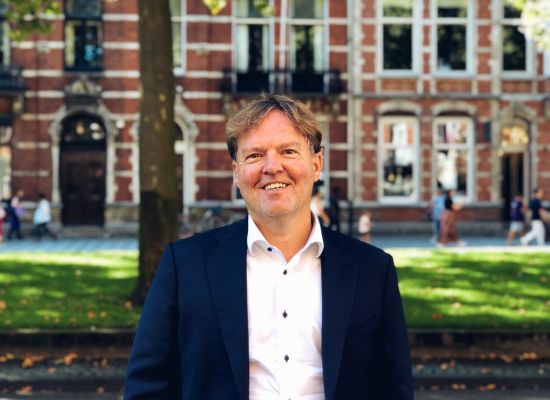
You have been a member of RINIS’ Supervisory Committee since January 2023. Why did you agree to become a member at the time?
"I spent working for the Ministry of Justice for close to 20 years, where one of the things I’d been involved with was e_CODEX, a digital exchange platform for European judicial organisations. In May 2019, I switched roles within the department, taking up a post with the office of the National Co-Ordinator for the Fight Against Anti-Semitism, which meant I was no longer involved with the operational side of the exchange of information. The idea of being able to continue to follow up on developments from a greater distance very much appealed to me. It allowed me to draw on my experience whilst simultaneously overseeing the sector with a fresh pair of eyes. Now that I’m serving as the manager at De Bruggenbouwers, I get a handle on the organisation of data exchanges in the public sector, looking in from the outside.”
How does this help you in this role?
“At De Bruggenbouwers, we assist government organisations with translating the needs of residents and business owners into concrete adjustments of rules and internal processes. These are the end users of a wide number of processes to do with the supply of information. Talking to these people makes it clear that the practical implementation of policies devised at departments meets with resistance. This is something I’d previously noticed when I was working on e-CODEX, for which I spoke to notaries, bailiffs, public prosecutors, staff at child protection services, etc. in various countries, only to find a lot of work remains to be done in terms of linking policy and practice. The degree of arm's length I now have in relation to government, to RINIS and its participants enables me to view matters through the prism of a non-stakeholder. Asking questions such as: what is it that is being done here? What are the needs to be addressed?”
What kind of things in particular do you look out for at RINIS?
“My motivation is the rule of law. I believe it’s essential that the exchange of data is legitimate and is effectively aimed at serving citizens and business owners. Another element I believe is important is RINIS’ agility. We are dealing with technological and social developments that are unfolding at break-neck speed, something which requires a high degree of adaptability. By the same token, we need to be critical of the technologies we implement. This is something RINIS does well; the organization does not just blow anywhere the technology wind blows; the organization makes duly considered choices with a strong focus on the needs and requirements of the participants.”
Which of RINIS’ ambitions appeal to you?
"What I find interesting is RINIS’ vision of the future of secure communications, data sharing within Europa. RINIS has been quick to spot this as a topic that is of major interest to participants such asthe SVB and the UWV and is patently capable of acting in response. With something like sTesta Next Generation for instance, the channel for safe communications for public organisations in Europe. Another thing I believe is characteristic of RINIS is the fact that the data centre ultimately ended up not being integrated as part of the national government’s ICT environment, because the organisation felt they needed to ensure quality standards for their participants. This sovereign consideration shows integrity on the part of the organisation in wanting to meet the guarantees offered to participants. I can sense this distinct technical focus to offer participants whatever it is they are in need of, whilst being unafraid to go beyond administrative conventions.”
What can RINIS do to make sure its services are duly in keeping with the developments over at participants’ and clients’?
"RINIS holds a unique position in that it is independent of specific departments. This enables the organisation to adopt a neutral and proactive role in the delivery of public services. The organisation has no hidden commercial agenda. It simply seeks to provide secure, reliable and guaranteed services. Something that is reflected in the way it goes about things. For instance, they take their time to speak to their participants and clients properly. The resulting feedback is effectively used to improve the service delivery. This ensures that they not only comply with the current expectations but are also prepared for future developments, such as quantum technology."
Which social or technological developments do you follow up on with particular interest as a supervisor?
"I closely monitor the way in which data sharing is developing in the delivery of public services. There is a distinct societal need for greater co-operation between various information exchanges that work together to share the data held at large competent institutions, pension funds and municipal authorities, thereby delivering better services to citizens and businesses. This in turn also has an impact at administrative level. I can see a major role for RINIS as part of this dynamic, precisely because of their independent position. They are able to make a substantive technical contribution to the co-operation between various parties, without getting ensnared by political or administrative interests. That is what I am committed to: co-operation in order to offer social added value."